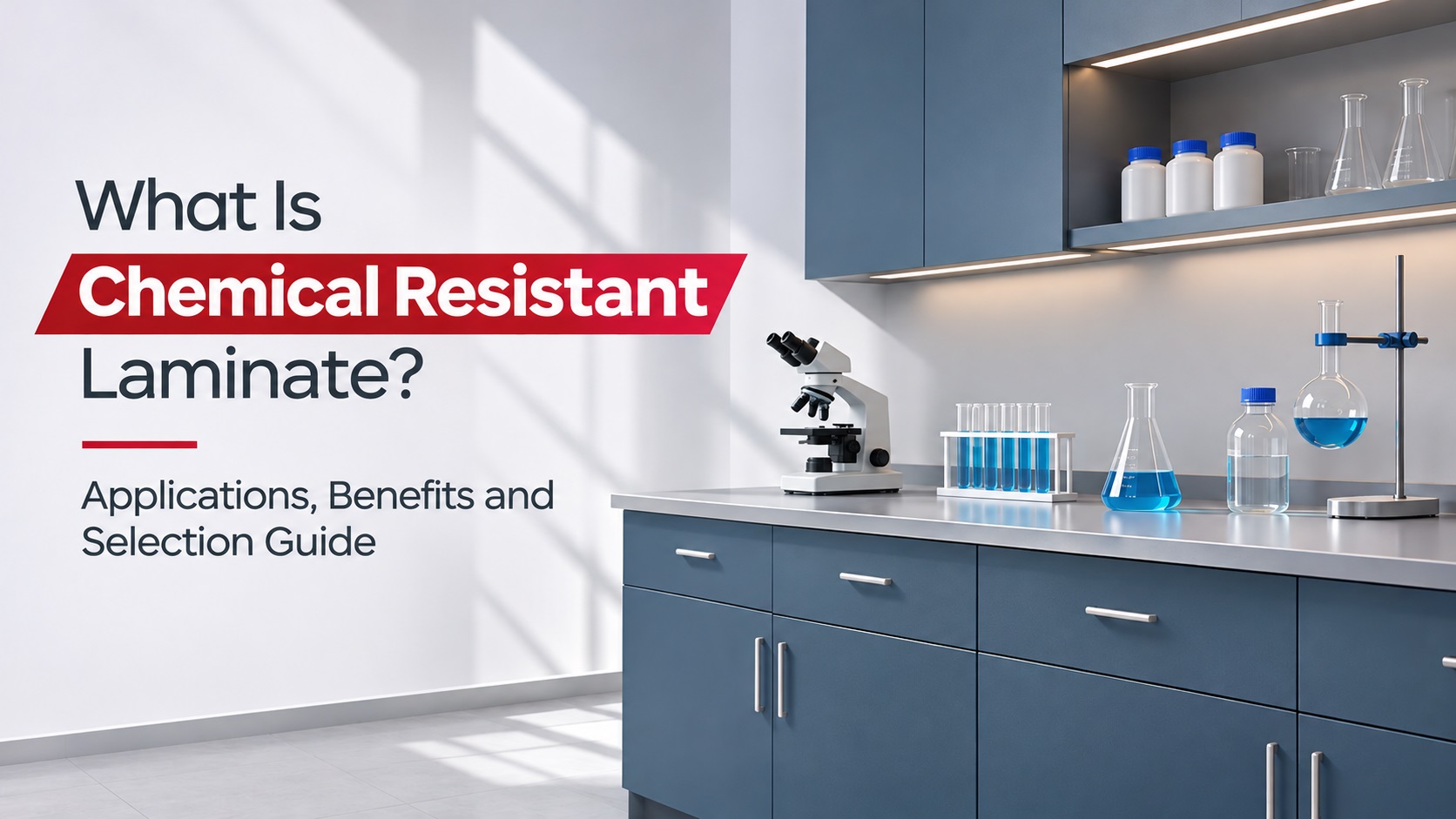
Laboratories, hospitals, pharmaceutical facilities and research centres require work surfaces that can withstand demanding working conditions. These environments regularly involve exposure to chemicals, cleaning agents, moisture and frequent use. Choosing the right surface material is therefore essential for maintaining durability, hygiene and long-term performance.
This is where chemical resistant laminate becomes an important surface solution. Designed for environments where ordinary decorative surfaces may not be suitable, chemical-resistant laminates help protect worktops, counters and other surfaces against specific chemical exposure, stains and everyday wear.
In this guide, we explore what chemical resistant laminate is, how it works, its major benefits, common applications and the factors to consider when selecting the right material. We will also look at Stylam's Lab Mate range of lab-grade compact panels, developed for demanding laboratory and healthcare environments.
What Is Chemical Resistant Laminate?
Chemical resistant laminate is a specially engineered surface material designed to withstand contact with selected chemicals, laboratory reagents, cleaning solutions and other potentially damaging substances.
Unlike conventional decorative laminates intended primarily for furniture and interior applications, chemical-resistant surfaces are developed for more demanding environments. Their performance depends on their material composition, manufacturing technology, surface construction and resistance to the specific chemicals they may encounter.
These laminates are commonly used to create laboratory worktops, countertops, workstations, cabinets and other surfaces where cleanliness and resistance to chemical exposure are important.
However, it is important to understand that no surface material is resistant to every chemical under every condition. Resistance can vary depending on chemical concentration, temperature, exposure duration and cleaning practices. Always consult the manufacturer's chemical-resistance data before specifying a surface for a particular application.
How Does Chemical Resistant Laminate Work?
Chemical resistant laminate is manufactured using specialized materials and surface technologies that help provide protection against specific chemical and environmental conditions.
The performance of a laminate surface generally depends on several factors:
- Surface protection: The engineered surface helps resist contact with selected chemicals and staining agents.
- Material construction: The composition and structure contribute to durability and overall performance.
- Manufacturing technology: Advanced curing and processing methods can improve the properties of the finished surface.
- Maintenance practices: Appropriate cleaning and timely removal of spills help preserve surface performance.
For laboratory applications, selecting a product based on documented chemical-resistance performance is particularly important. A general claim of chemical resistance should not replace product-specific test information.
Key Benefits of Chemical Resistant Laminate
Choosing an appropriate chemical-resistant surface can offer several advantages in laboratories, healthcare facilities and industrial environments.
1. Resistance to Selected Chemicals
One of the most important benefits is its ability to withstand exposure to specified chemicals and laboratory substances. This helps protect work surfaces from damage when used according to the manufacturer's recommendations.
2. Improved Stain Resistance
Laboratory worktops may come into contact with reagents, solutions and other substances that can leave marks. Chemical-resistant surfaces help reduce staining from compatible substances and support a cleaner working environment.
3. Durability for Demanding Environments
Laboratories and research facilities experience frequent daily use. A suitable compact laminate surface provides a durable solution for workstations and counters exposed to regular handling and demanding operating conditions.
4. Hygiene and Easy Maintenance
Cleanliness is essential in healthcare, pharmaceutical and laboratory settings. A surface designed for these applications can support routine cleaning and maintenance. Always follow the recommended cleaning procedure to avoid damaging the surface.
5. Long-Term Surface Performance
Selecting a surface suited to its intended working conditions can help reduce premature deterioration and the need for frequent replacement. Correct installation, maintenance and chemical compatibility checks are essential to achieving long-term performance.
6. Suitable for Specialized Applications
Chemical-resistant laminate solutions are useful in environments where conventional furniture surfaces may not provide the required level of performance. They can be specified for laboratory worktops, healthcare workstations and research facility furniture, subject to product suitability.
Major Applications of Chemical Resistant Laminate
Chemical-resistant surfaces are used in several professional environments where worktops and furniture must withstand specific chemical exposure and regular cleaning.
1. Chemical and Research Laboratories
Chemical laboratories regularly handle acids, alkalis, solvents and other reagents. Work surfaces must be selected according to the chemicals used and the expected exposure conditions.
Chemical resistant laminate countertops can provide a practical surface option for laboratory benches, preparation areas and research workstations when the product's documented resistance matches the application.
2. Pharmaceutical Laboratories
Pharmaceutical facilities require surfaces that support organized workflows, routine cleaning and controlled working environments. Chemical-resistant compact panels can be considered for laboratory workstations, storage furniture and selected work areas.
3. Hospitals and Healthcare Facilities
Healthcare environments require surfaces that can withstand frequent cleaning and regular use. Suitable chemical-resistant laminate surfaces can be used in laboratory counters, diagnostic workstations and healthcare furniture, depending on the cleaning agents and performance requirements.
4. Educational and Institutional Laboratories
Schools, colleges and universities use laboratories for practical experiments, demonstrations and research activities. Durable work surfaces can help support everyday laboratory operations while providing a functional and easy-to-maintain workspace.
5. Industrial Testing and Quality Control Facilities
Manufacturing facilities often have testing departments where materials, chemicals and samples are examined. Chemical-resistant worktops can be considered for inspection stations, testing benches and quality-control work areas.
6. Microbiology and Analytical Laboratories
Microbiology and analytical laboratories require organized workspaces and surfaces that support regular cleaning. The selected surface should be compatible with the disinfectants, reagents and other substances used in the facility.
Why Choose Compact Laminate for Laboratory Worktops?
Compact laminate is a high-density, self-supporting panel designed for applications that demand strength and durability. It is commonly used in commercial interiors, washrooms, laboratories and other demanding spaces.
Its dense construction makes it suitable for applications where moisture resistance, impact resistance and long-lasting surface performance are important.
For laboratory environments, however, general compact laminate properties should not be confused with specialized chemical-resistance performance. The panel must be selected according to its tested suitability for the chemicals and conditions involved.
Stylam's Lab Mate range is specifically developed for laboratory and healthcare environments. Its lab-grade compact panels use advanced acrylic resin technology and electron beam curing. The range is designed for environments exposed to harsh chemicals, water and contamination.
The Lab Mate range highlights features including:
- Chemical resistance
- High durability
- Stain-resistant surface performance
- Anti-bacterial properties
- Suitability for specialised laboratory and healthcare applications
Explore Stylam Lab Mate – Lab-Grade Compact Panels to learn more about the product range.
You can also explore Stylam Compact Laminates for additional high-density surface solutions designed for demanding interior and commercial applications.
Chemical Resistant Laminate vs Ordinary Decorative Laminate
Not all laminates are designed for the same purpose. Decorative laminates are primarily selected for their appearance, surface finish and everyday performance in furniture and interior applications. Chemical-resistant laminates are selected for environments where exposure to specific chemicals is an important consideration.
|
Comparison Factor
|
Ordinary Decorative Laminate
|
Chemical Resistant Laminate
|
|
Primary purpose
|
Furniture and interior finishes
|
Specialised work surfaces
|
|
Chemical exposure
|
Depends on product; not necessarily designed for laboratory use
|
Designed to resist specified chemicals
|
|
Typical applications
|
Wardrobes, cabinets and furniture
|
Laboratory worktops and specialised counters
|
|
Selection criteria
|
Design, finish and general durability
|
Chemical compatibility and test performance
|
|
Maintenance
|
Routine surface cleaning
|
Cleaning according to manufacturer guidelines
|
The right choice depends on the intended application. A decorative laminate should not be used as a laboratory work surface unless its documented performance meets the required conditions.
How to Select the Right Chemical Resistant Laminate
Choosing a suitable surface requires more than comparing appearance or price. Consider the following factors before making a decision.
1. Identify the Chemicals Used
Prepare a list of all chemicals, reagents, solvents and cleaning agents that may come into contact with the surface. Include their concentrations and expected exposure conditions.
2. Check Chemical Resistance Data
Ask the manufacturer for product-specific chemical-resistance information. Review the test method, chemicals tested, exposure duration and acceptance criteria.
3. Consider the Application Environment
A university laboratory, pharmaceutical facility and industrial testing area may have different performance requirements. Select a product according to the actual working environment.
4. Evaluate Durability and Moisture Resistance
Laboratory surfaces may experience frequent use, cleaning and accidental spills. Consider the panel's durability, moisture resistance and suitability for the intended installation.
5. Review Hygiene and Cleaning Requirements
Check whether the surface is compatible with the disinfectants and cleaning agents used at the facility. Follow the manufacturer's instructions for cleaning and maintenance.
6. Confirm Thickness, Dimensions and Installation Requirements
The panel dimensions, thickness, edge treatment, support structure and installation method should match the project requirements. Consult the manufacturer or fabricator before finalising specifications.
7. Request Technical Documentation
Before purchasing, request relevant product specifications, test reports, maintenance instructions and warranty details. This helps architects, laboratory planners and facility managers make an informed decision.
Understanding Laboratory Work Surface Testing
When selecting laboratory worktops, it is useful to understand recognised industry testing guidance.
The Scientific Equipment and Furniture Association (SEFA) publishes standards for laboratory furniture and work surfaces. Its SEFA 3 document addresses laboratory work-surface performance criteria, including chemical and stain resistance, abrasion and scratch resistance, ease of cleaning, heat and cold resistance, impact resistance and other relevant characteristics.
You can refer to the SEFA 3 Laboratory Work Surfaces Standard for further information.
Remember that referring to a standard does not automatically mean a particular product is certified or compliant with it. Always request the relevant test documentation from the manufacturer and verify that it applies to the exact product being specified.
Why Consider Stylam Lab Mate for Laboratory Applications?
Laboratory surfaces need to combine functional performance with durability and ease of maintenance. Stylam's Lab Mate range is designed specifically for demanding laboratory and healthcare environments.
Manufactured using advanced acrylic resin technology and electron beam curing, Lab Mate lab-grade compact panels are developed for environments exposed to chemicals, water and contamination.
The range is intended for applications such as:
- Chemical laboratories
- Analytical and microbiological laboratories
- Pharmaceutical facilities
- Hospital workstations
- Educational and research laboratories
- Laboratory worktops and cabinetry
The available Lab Mate colours include White, Grey and Black. For dimensions, technical details, chemical compatibility and project-specific requirements, consult Stylam directly.
Discover the Stylam Lab Mate product range or contact the Stylam team for product enquiries.
Frequently Asked Questions About Chemical Resistant Laminate
1. What is chemical resistant laminate used for?
Chemical resistant laminate is used for work surfaces and furniture in environments where exposure to selected chemicals, cleaning agents and staining substances is expected. Common applications include laboratories, pharmaceutical facilities, healthcare workstations and research centres.
2. Is chemical resistant laminate suitable for laboratory countertops?
Yes, specialised chemical-resistant laminate products can be suitable for laboratory countertops when their documented chemical resistance matches the chemicals and working conditions in the facility.
3. What is the difference between chemical resistant laminate and compact laminate?
Compact laminate is a high-density, self-supporting panel designed for strength and durability. Chemical resistant laminate refers to a surface solution selected for its resistance to specified chemicals. Some specialised compact laminate products, such as Stylam Lab Mate, are developed for laboratory environments.
4. Can chemical resistant laminate withstand acids and solvents?
Resistance depends on the specific acid or solvent, its concentration, temperature and exposure duration. Always check the manufacturer's chemical-resistance chart or test report before using a surface with a particular chemical.
5. Is chemical resistant laminate easy to maintain?
Suitable chemical-resistant surfaces can support routine cleaning and maintenance. Use only cleaning agents approved by the manufacturer and remove spills according to the recommended maintenance procedure.
6. What is Stylam Lab Mate?
Stylam Lab Mate is a range of lab-grade compact panels developed for laboratory and healthcare environments. It uses advanced acrylic resin technology and electron beam curing and is designed for durability, chemical resistance, stain resistance and hygiene-focused applications.
7. How do I choose the best chemical resistant laminate?
Identify the chemicals used in your facility, review product-specific test data, evaluate durability and moisture resistance, and confirm that the panel meets your installation and maintenance requirements. Request technical documentation before finalising your selection.
Conclusion
Choosing the right chemical resistant laminate is an important decision for laboratories, hospitals, pharmaceutical facilities and research environments. The ideal surface should match the chemicals used, support routine cleaning and provide the durability required for everyday operations.
Compact laminate panels designed for specialised environments can offer a practical solution for laboratory worktops, counters and workstations. With its purpose-built Lab Mate range, Stylam offers lab-grade compact panels developed for demanding applications.
Explore Stylam Lab Mate and Stylam Compact Laminates to find a surface solution for your next laboratory or healthcare project. For technical specifications and product enquiries, connect with the Stylam team.