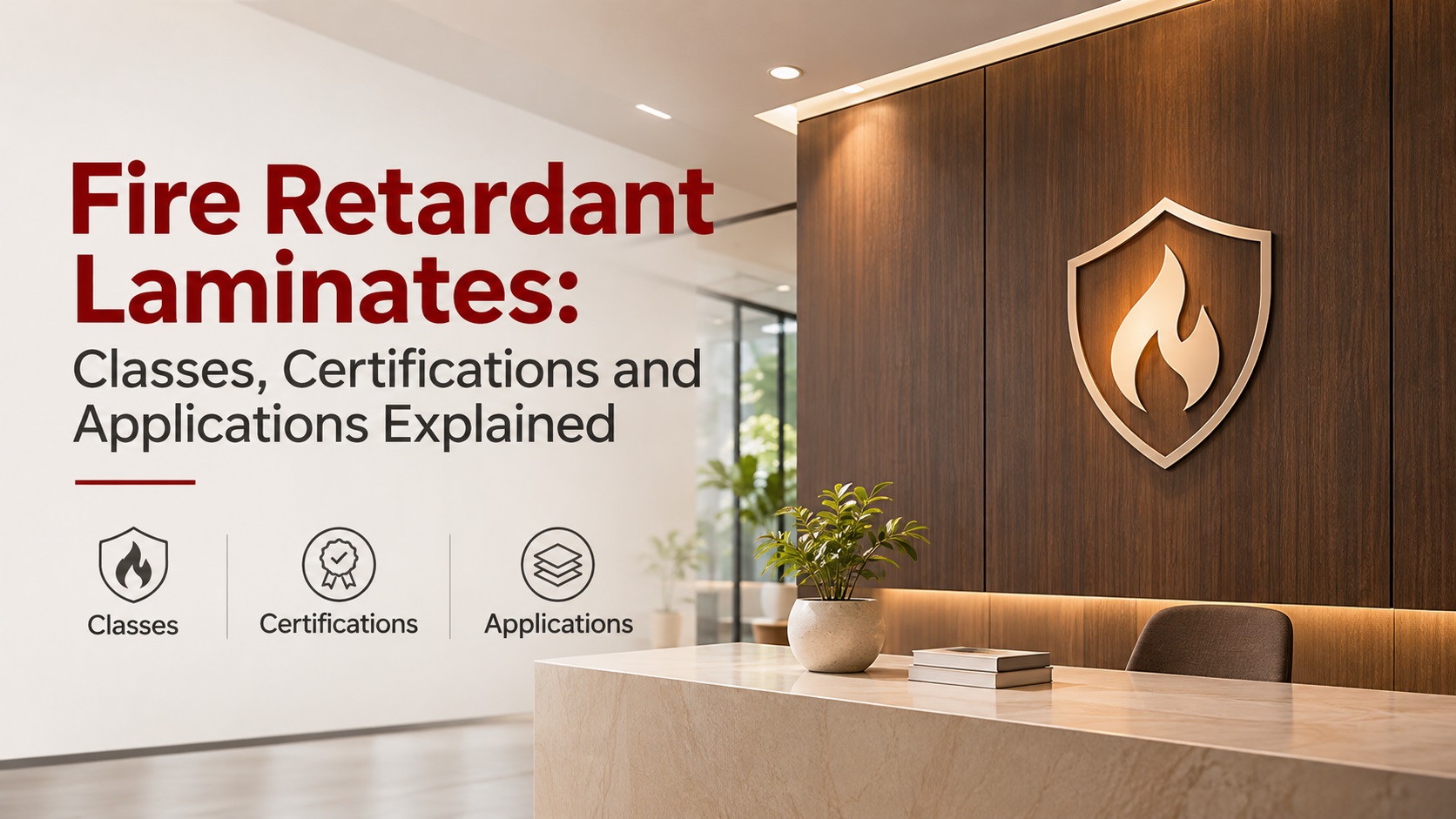
Fire safety is an important consideration when selecting materials for modern interiors. In commercial buildings, hospitals, educational institutions, offices and public spaces, every surface and finish must be selected with the building’s overall fire-safety requirements in mind. This is where fire retardant laminates become an important material to understand.
Designed to help limit the spread of flame or contribute to improved fire performance when appropriately tested and specified, fire-retardant laminate products can be considered for a range of interior applications. However, not all laminates have the same fire performance, and terms such as fire retardant, fire resistant and fire rated should not be used interchangeably.
Understanding fire classifications, test standards, certifications and application requirements helps architects, interior designers, contractors and facility managers make informed material decisions.
In this guide, we explain what fire retardant laminates are, how their classes and certifications work, where they may be used and what to check before specifying them.
What Are Fire Retardant Laminates?
Fire retardant laminates are surface materials formulated or treated to achieve a specified level of performance when exposed to fire or flame. Depending on their composition and construction, they may help delay ignition, reduce flame spread or meet particular reaction-to-fire requirements.
These laminates are generally manufactured using decorative layers combined with resin-based materials under controlled heat and pressure. Fire-retardant formulations may incorporate specialised additives or other material technologies intended to influence how the product behaves when exposed to heat and flame.
Their actual performance depends on the complete product construction, thickness, substrate, installation method and applicable test standard. A laminate should therefore never be assumed to be fire rated simply because it is described as a specialty or high-pressure laminate.
Fire Retardant vs Fire Resistant: What Is the Difference?
The terms are related, but they describe different aspects of fire performance.
- Fire retardant: Describes a material designed or formulated to slow ignition or flame spread under specified test conditions.
- Fire resistant: Generally describes the ability of a material or building element to withstand fire exposure for a defined period while maintaining specified performance.
- Fire rated: Indicates that a product or building assembly has been tested and classified against a particular standard or requirement.
For example, a surface laminate may have a reaction-to-fire classification, while a complete wall or door assembly may have a fire-resistance rating. These are not interchangeable results.
How Do Fire Retardant Laminates Work?
The fire performance of a laminate depends on its material composition and how it responds to heat. Special formulations may be designed to influence ignition, combustion and flame propagation.
Depending on the product, fire-retardant technologies may help:
- Delay ignition: Formulations may make ignition more difficult under the conditions of a specific test.
- Limit flame spread: The material may achieve a specified flame-spread performance when tested using the relevant method.
- Influence heat release: Some formulations are designed to affect the amount or rate of heat released during combustion.
- Address smoke and droplets: Certain classification systems separately assess smoke production and flaming droplets or particles.
These properties must be confirmed through product-specific test reports. A fire-retardant claim alone does not tell you how much smoke a material produces, whether it forms flaming droplets or how long a complete building element can withstand fire.
Understanding Fire Classes and Ratings
One of the most important steps when selecting fire retardant laminates is understanding the classification system mentioned in the product documentation.
Different countries and industries use different standards. A classification under one standard cannot automatically be converted into a rating under another.
1. EN 13501-1: European Reaction-to-Fire Classification
EN 13501-1 is a European classification standard used to classify the reaction-to-fire performance of construction products. It uses classes from A1 to F, with additional classifications for smoke production and flaming droplets or particles where applicable.
A simplified overview is:
| Euroclass |
General Meaning |
| A1 |
No contribution to fire under the classification criteria |
| A2 |
Very limited contribution to fire |
| B |
Limited contribution to fire |
| C |
Limited, but greater contribution than B |
| D |
Acceptable performance under the defined criteria |
| E |
Basic reaction-to-fire performance |
| F |
Performance not determined or does not meet the required classes |
Additional suffixes provide further information:
- s1, s2 and s3: Indicate smoke-production classifications, with s1 representing the lowest smoke-production category.
- d0, d1 and d2: Indicate classifications relating to flaming droplets or particles, with d0 representing no flaming droplets or particles under the relevant test conditions.
For example, a classification such as B-s1,d0 combines the main reaction-to-fire class with smoke and flaming-droplet classifications.
The complete classification must be read from the relevant report and applied only to the product and intended use covered by that evidence.
2. ASTM E84: Surface Burning Characteristics
ASTM E84 is a test method used to evaluate the surface burning characteristics of building materials. It measures factors including flame spread and smoke development under the test conditions.
Results are commonly discussed using flame spread index (FSI) and smoke developed index (SDI). In some specifications, materials are grouped into Class A, Class B and Class C categories based on defined index ranges.
A commonly referenced grouping is:
| Classification |
Flame Spread Index (FSI) |
| Class A |
0–25 |
| Class B |
26–75 |
| Class C |
76–200 |
Always check the applicable specification and test report for the exact requirements, including smoke-developed limits. ASTM E84 results are not equivalent to EN 13501-1 Euroclasses.
3. Other Standards and Product Requirements
Depending on the country, building type and intended application, project specifications may refer to other national or international fire-test methods.
The correct standard depends on factors such as:
- Whether the product is used as a wall, ceiling, floor or furniture surface.
- Whether the requirement concerns reaction to fire or fire resistance.
- The substrate and installation system.
- The building code and project specification.
- The occupancy and fire-safety strategy of the building.
Architects and specifiers should confirm the required test method with the project’s fire consultant or relevant authority before choosing a material.
Certifications and Documents to Check Before Buying
A fire-related claim should always be supported by suitable product documentation. A brochure statement or general company certificate is not a substitute for a test report covering the actual product.
Before selecting fire retardant laminates, ask the manufacturer or supplier for:
1. Product-specific test report
Check that the report identifies the exact product, grade, thickness and tested construction. Confirm that the test method and result match the project requirement.
2. Classification report
Where a classification system applies, request the classification document and check the stated class, scope and conditions of use.
3. Accreditation and testing details
Review the testing laboratory, report number, issue date and relevant accreditation details. Confirm that the report can be verified where necessary.
4. Substrate and installation conditions
Fire performance can depend on the material behind the laminate, adhesives, air gaps, joints, fixings and installation method. Ask whether the test result applies to the complete assembly or only to the laminate material.
5. Compliance with local building requirements
A product that meets one test standard may not automatically satisfy every local building regulation or project specification. Confirm requirements for the building’s location and intended use.
6. Validity and scope
Check whether the documentation covers the proposed thickness, finish, colour range, manufacturing location and intended application. Do not assume that a report for one product variant applies to every product in a collection.
Key Benefits of Fire Retardant Laminates
When a product has been appropriately tested and selected for the intended application, fire-retardant laminates may offer several practical benefits.
1. Specified Fire Performance
The primary benefit is the ability to select a surface material with documented fire performance for a defined application. This can help project teams meet material specifications and support a broader fire-safety strategy.
2. Design Flexibility
Depending on the manufacturer and product range, specialist laminates may be available in different colours, patterns and surface finishes. This allows designers to consider appearance alongside technical requirements.
3. Practical Surface Performance
Many laminate products are selected for their everyday surface characteristics, such as ease of cleaning, resistance to wear and design versatility. These properties vary by product and should be checked separately from fire-test results.
4. Suitability for Specified Interior Applications
Where the product documentation and building requirements permit, appropriately classified laminate surfaces may be considered for selected commercial, institutional and public-interior projects.
5. Integration with Interior Design
Decorative surface materials can help create coordinated interiors across furniture, wall panels, cabinetry and other elements. The selected laminate must still meet the performance requirements for each application.
Applications of Fire Retardant Laminates
The choice of laminate depends on the building’s occupancy, fire-safety design and the performance requirements of each surface.
1. Commercial Offices
Offices use surface materials across workstations, storage units, reception counters and selected wall features. Where fire performance is specified, the product and complete installation should be checked against the project requirements.
2. Hospitals and Healthcare Facilities
Healthcare interiors require careful material selection because of occupancy, evacuation and operational considerations. Laminates may be considered for selected furniture, cabinetry and wall applications when their technical documentation supports the intended use.
3. Educational Institutions
Schools, colleges, universities and training centres contain classrooms, libraries, laboratories and common areas. Material specifications should consider the building’s fire-safety requirements, durability and maintenance needs.
4. Hotels and Hospitality Spaces
Hotels and hospitality projects use decorative surfaces in guest rooms, reception areas, corridors and furniture. Designers should confirm the required fire classification for each application rather than relying on a general product description.
5. Retail and Public Interiors
Retail stores, showrooms, shopping centres and public spaces often combine decorative finishes with specific building-material requirements. The selected surface should be supported by documentation appropriate to its intended use.
6. Transportation and Specialised Interiors
Some transport and specialist environments follow their own material fire-test requirements. A building-material classification should not be assumed to satisfy a transport-sector standard. Always verify the applicable specification for the vehicle, vessel or installation.
Fire Retardant Laminates vs Regular Decorative Laminates
Both material categories can offer decorative surface finishes, but their documented fire performance may differ.
|
Feature
|
Regular Decorative Laminates
|
Fire-Retardant Laminates
|
|
Primary selection focus
|
Appearance and everyday surface performance
|
Specified fire performance alongside surface requirements
|
|
Fire classification
|
Must be checked; do not assume a rating
|
Should be supported by relevant test documentation
|
|
Material formulation
|
Varies by product
|
May include fire-retardant formulation or technology
|
|
Applications
|
Furniture, cabinetry and interior surfaces
|
Applications where a defined fire-performance requirement applies
|
|
Documentation
|
Product and performance data
|
Product data plus relevant fire-test and classification evidence
|
The most suitable option depends on the project specification. A regular decorative laminate should not be described as fire retardant without supporting test evidence.
How to Choose the Right Fire Retardant Laminate
Selecting the right product involves more than comparing colours and finishes. Use the following checklist before placing an order.
1. Identify the Required Fire Standard
Ask the architect, consultant or project authority which standard and classification are required. Do not choose a product based only on a general statement such as “fire safe”.
2. Confirm the Intended Application
A laminate used on furniture may have different requirements from a product used on a wall or ceiling. Confirm the exact location and function of the surface.
3. Review the Complete Test Documentation
Check the product name, thickness, substrate, installation conditions, test method and classification. Make sure the documentation covers the proposed use.
4. Consider Smoke and Flaming Droplet Requirements
Where the classification system includes smoke and flaming-droplet categories, review those results as well as the main fire class.
5. Evaluate Other Performance Needs
Consider cleaning, scratch resistance, impact resistance, moisture exposure, chemical contact and expected maintenance. Fire performance does not automatically establish these other properties.
6. Coordinate with the Project Team
Share the product documentation with the architect, fire consultant, contractor and relevant approving authority. Confirm acceptance before installation.
Exploring Specialty Laminates for Modern Interiors
Specialty laminates are developed to address specific design and functional requirements beyond conventional decorative surfaces. Depending on the product, these may include distinctive finishes, writable surfaces, magnetic functionality, reflective effects or specialised performance characteristics.
Stylam’s Specialty Laminates collection brings together surface solutions for different interior applications. The range includes options such as Metallic Laminates, Mirror Laminates, Magnetic Laminates, Chalk & Marker Laminates, Digital Laminates and Electrostatic Dissipative Laminates.
Each product is designed for its own intended purpose. For example, Electrostatic Dissipative Laminates are intended for environments where controlling electrostatic discharge is important. They should not be confused with fire-retardant products, as these address different performance requirements.
Explore the Stylam Specialty Laminates collection to discover decorative and functional surface options. For project-specific requirements, contact the Stylam team to discuss product suitability and available technical documentation.
Frequently Asked Questions About Fire Retardant Laminates
1. What are fire retardant laminates?
Fire retardant laminates are surface materials designed or formulated to achieve specified fire-performance characteristics under defined test conditions. Their actual classification must be confirmed through product-specific test documentation.
2. Are fire retardant and fire resistant laminates the same?
No. Fire retardant generally refers to a material’s ability to influence ignition or flame spread. Fire resistance usually relates to how long a material or building element can maintain specified performance during fire exposure. The relevant test and classification determine what a product claim means.
3. What are Class A, B and C fire ratings?
These labels are commonly used in connection with ASTM E84 surface-burning results. They are based on flame-spread index ranges, with Class A representing the lowest range. Always check the full test report and applicable specification, including smoke-developed requirements.
4. What does B-s1,d0 mean?
B-s1,d0 is a European reaction-to-fire classification under EN 13501-1. It combines the main fire class B with an s1 smoke classification and a d0 flaming-droplet classification. It should only be quoted where a valid classification report supports it.
5. Can fire retardant laminates be used in hospitals and schools?
They may be considered for selected applications when the product has the required documentation and meets the building’s project specifications. The final selection should be reviewed by the relevant design and fire-safety professionals.
6. Does every high-pressure laminate have a fire rating?
No. High-pressure laminate describes a type of laminate construction; it does not automatically establish a particular fire classification. Check the exact product’s technical documentation.
7. How can I verify a laminate’s fire rating?
Request the product-specific test report and classification documentation. Verify the standard, laboratory, tested thickness, substrate, installation conditions and scope of use.
Conclusion
Fire retardant laminates can be an important material option in projects where surface fire performance is part of the specification. However, choosing the right product requires a clear understanding of fire classes, test standards, certification documents and installation conditions.
Whether you are designing an office, healthcare facility, educational building, hotel or public interior, always verify that the selected laminate meets the requirements for its exact application. Fire classifications should be supported by valid product-specific evidence and reviewed as part of the building’s overall fire-safety strategy.
Explore Stylam Specialty Laminates for functional and decorative surface solutions, or contact Stylam for product-related enquiries and technical information.